


- Why China and East Asia Are Attractive Markets
- Understanding Regulations and Risks
- Pre-Export Preparations
- Logistics and Shipping
- Marketing and Sales Strategies
- Challenges and Risk Mitigation
- Case Study: How a 20-Ton Pistachio Shipment Reached Shanghai in 70 Days
- Future Trends and Outlook
- Conclusion
Introduction
With the rapid rise of middle-class consumers and a growing appetite for healthy snacks, East Asia has become one of the most dynamic destinations for Iranian pistachios. Exporting Iranian pistachios to China, Japan, South Korea, and neighboring markets is a significant opportunity as these regions are experiencing record-high nut consumption — driven by gifting culture, online retail, and wellness trends.
However, entering this market requires more than just high-quality nuts. It demands regulatory precision, packaging excellence, and long-term partnerships. This step-by-step guide walks you through every stage — from farm preparation and documentation to logistics, customs, and marketing — helping exporters reduce risk, ensure compliance, and build sustainable growth in Asia’s fastest-expanding pistachio markets.
Why China and East Asia Are Attractive Markets
Consumption Trends
- China is the largest pistachio importer in East Asia, with demand driven by festivals, gifting, and healthy snacking.
- Japan, South Korea, and Vietnam show a consistent rise in nut consumption, especially in premium snack and confectionery segments.
- The region’s average pistachio import growth stands at 5–7% annually.
Key Importers
- China : Strong demand for raw, roasted, and flavored pistachios.
- Japan: Prefers small-pack, hygienic, and well-branded products with clear labeling.
- South Korea: Growing e-commerce demand, similar to Japan’s market profile.
- Vietnam, Singapore, Malaysia: Serve as key re-export and distribution hubs.
Competitive Landscape
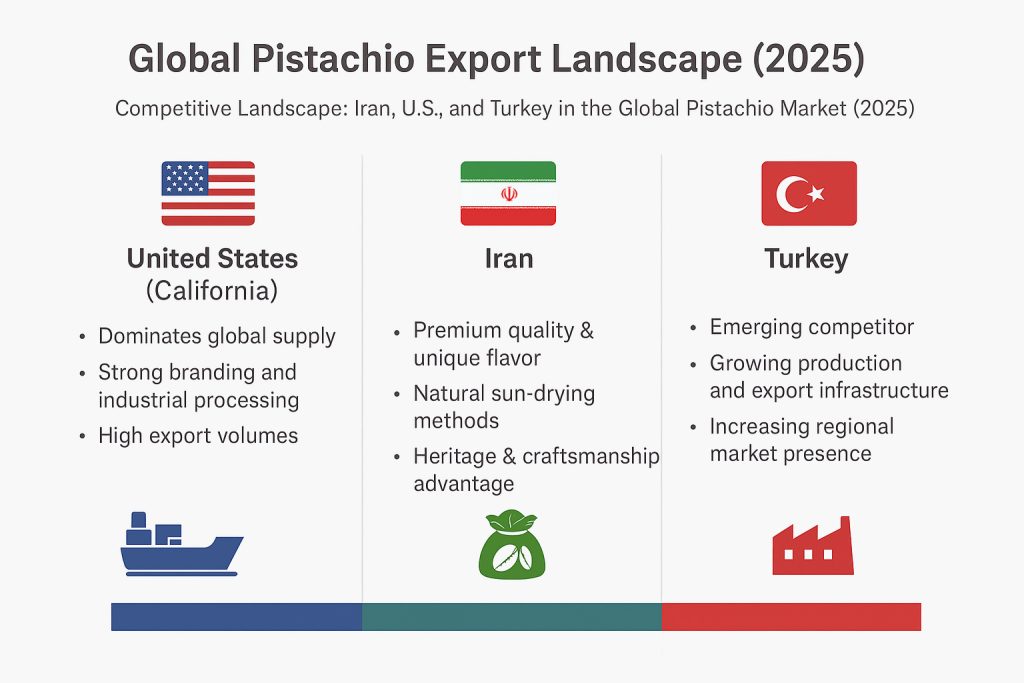
- United States (California): Dominates with high volumes and established brands.
- Iran: Differentiates through premium quality, unique flavor, and natural drying methods.
- Turkey: Emerging regional competitor with growing export capacity.
Understanding Regulations and Risks
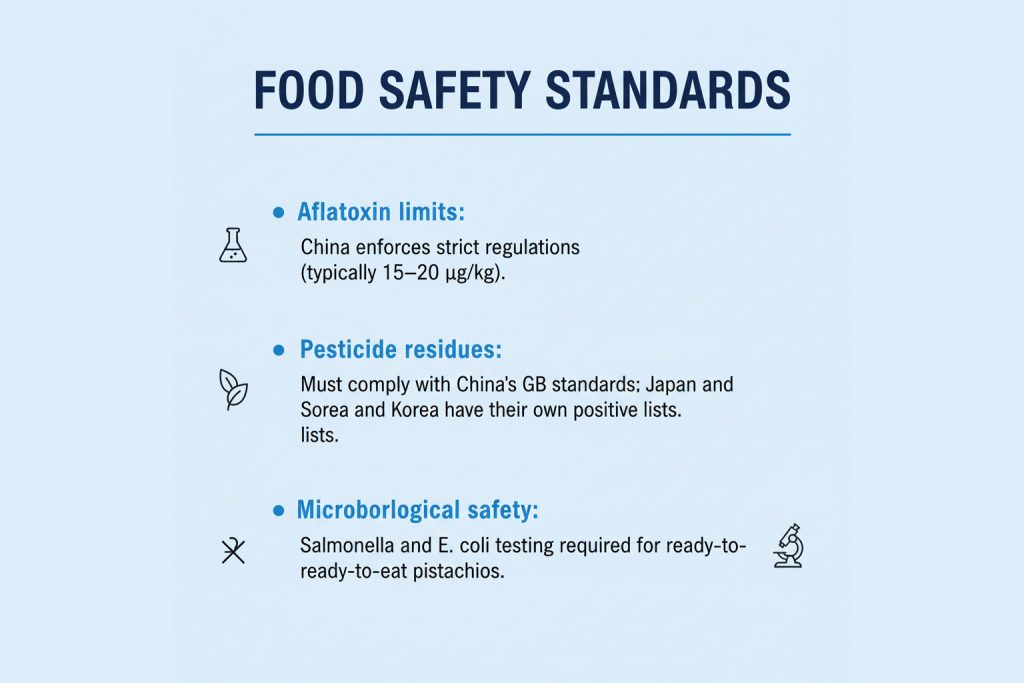
Food Safety Standards
- Aflatoxin limits: China enforces strict regulations (typically 15–20 μg/kg).
- Pesticide residues: Must comply with China’s GB standards; Japan and South Korea have their own positive lists.
- Microbiological safety: Salmonella and E. coli testing required for ready-to-eat pistachios.
Import Documentation
- Certificate of Origin: Mandatory for customs clearance.
- Phytosanitary Certificate: Required in some countries for raw shipments.
- Health Certificate / Lab Report: Must prove compliance with aflatoxin and pesticide limits.
- Product Labeling: Local language labeling is essential — Simplified Chinese, Japanese, or Korean depending on the market.
Tariffs and Trade Agreements
- China: Import duties typically 5–10%, lower under preferential trade deals.
- Japan & South Korea: Average tariffs 10–15%; FTAs can reduce these rates.
- Exporters should monitor updates from official sources such as GACC (China) and MHLW (Japan) to stay compliant.
Pre-Export Preparations
Selecting Pistachio Varieties
| Variety | Characteristics | Market Use |
| Akbari | Long, premium kernels | Gifting and retail packaging |
| Ahmad Aghaei | Attractive shape, bright color | Snacks and confectionery |
| Fandoghi | Smaller, cost-effective | Bulk processing and re-export |
| Kalleh Ghouchi | Large, round kernels | Bakery and snack industries |
On-Farm and Processing Practices
- Maintain strict control over irrigation and harvest timing to prevent aflatoxin growth.
- Sort defective nuts and foreign materials before storage.
- Store under low humidity and controlled temperature (<10°C, <65% RH).
Laboratory Testing

- Use accredited labs for aflatoxin, moisture, and pesticide analysis.
- Test multiple batches to minimize rejection risks at customs.
Packaging & Labeling
- B2B export: 25–50 kg vacuum-sealed or woven PP bags.
- Retail export: 200–500 g premium packs with multilingual labels.
- Include product name, country of origin, batch number, best-before date, nutrition facts, and certifications.
Logistics and Shipping
Shipping Routes
- Sea Freight: Bandar Abbas → Shanghai / Guangzhou / Singapore / Hong Kong.
- Air Freight: For small, high-value shipments (Japan, South Korea).
- Land + Sea: Used occasionally for Vietnam or Myanmar border trade.
Transit Considerations
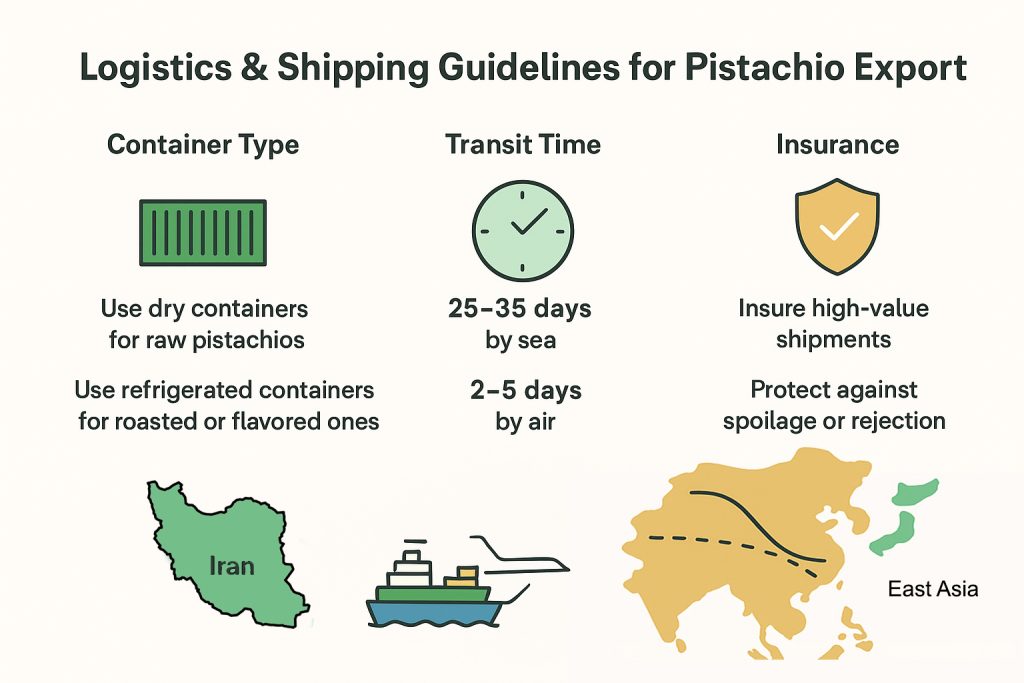
- Use dry containers for raw pistachios; refrigerated units for roasted, processed or flavored ones.
- Transit time: 25–35 days by sea, 2–5 days by air.
- Insure high-value shipments against spoilage or rejection.
Customs Clearance in East Asia
- Expect document verification, sampling, and aflatoxin/pesticide testing.
- Rejected shipments may be destroyed or returned, and exporters can face blacklisting.
- Submitting documents digitally in advance helps reduce clearance delays.
Marketing and Sales Strategies
China
- Focus on e-commerce platforms: JD.com, Tmall, Alibaba, and cross-border channels.
- Attend China International Import Expo (CIIE) to connect with bulk buyers.
- Packaging must feel gift-oriented and premium, reflecting Chinese consumer habits.
Japan and South Korea
- Smaller but high-value markets with strict hygiene and traceability standards.
- Local partnerships with importers or distributors are essential.
- Participate in Foodex Japan and Seoul Food & Hotel exhibitions.
Brand & Storytelling
- Highlight Iran’s pistachio heritage and natural cultivation methods.
- Incorporate storytelling in packaging — consumers in Japan and Korea value authenticity.
- In China, KOL and influencer collaborations can significantly boost visibility.
Pricing Strategy
- Prices depend on variety, quality, and packaging, and are commonly offered in CIF and FOB terms. Based on the customer’s demand and willingness, other terms and optional services are negotiable and will affect the final price.
- Include lab certificates and traceability documentation to justify premium pricing.
Challenges and Risk Mitigation
| Challenge | Mitigation Strategy |
|---|---|
| Aflatoxin contamination | Pre-harvest biocontrol, multiple batch testing |
| Customs delays | Submit digital documents early, maintain agent communication |
| Tariff fluctuations | Monitor trade policies, leverage FTAs |
| Payment risk | Use Letters of Credit (LC) or escrow services |
| Market competition | Emphasize premium taste, certification, and sustainability |
Case Study: How a 20-Ton Pistachio Shipment Reached Shanghai in 70 Days
| Day 0–20 | Harvesting, sorting, drying, and lab testing. |
| Day 21–30 | Packaging and labeling in 25–50 kg vacuum bags. |
| Day 31–35 | Document preparation (Invoice, Certificate of Origin, Phytosanitary Certificate). |
| Day 36–65 | Sea freight from Bandar Abbas to Shanghai. |
| Day 66–70 | Customs inspection, aflatoxin sampling, clearance, and delivery to warehouse. |
Lesson learned: Early communication with import agents and timely digital documentation can prevent costly clearance delays.
Future Trends and Outlook
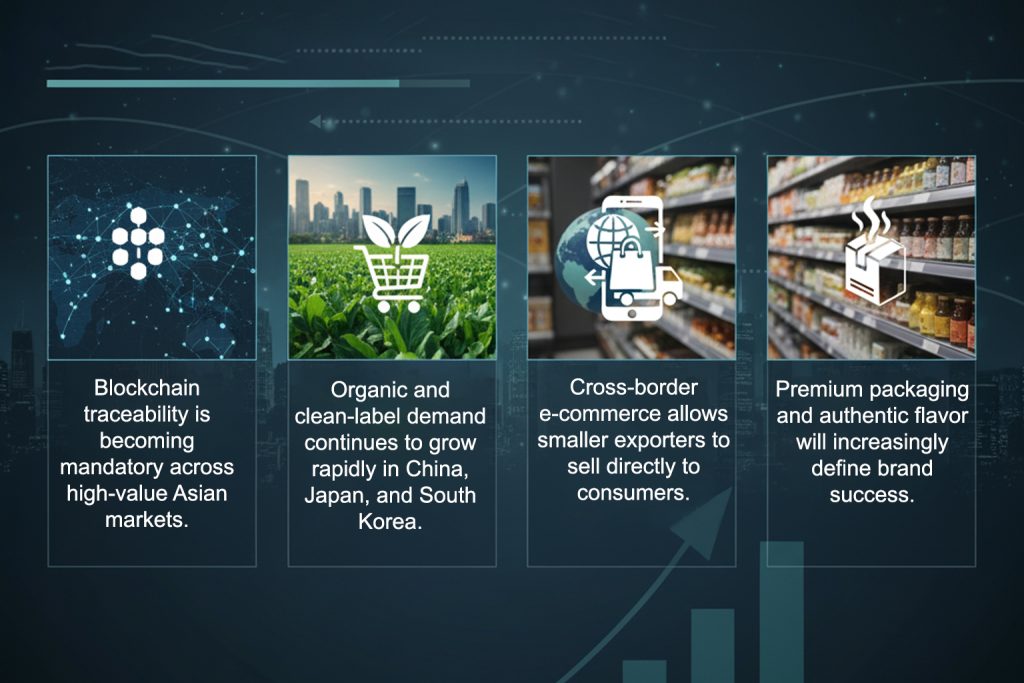
- Blockchain traceability is becoming mandatory across high-value Asian markets.
- Organic and clean-label demand continues to grow rapidly in China, Japan, and South Korea.
- Cross-border e-commerce allows smaller exporters to sell directly to consumers.
- Premium packaging and authentic flavor will increasingly define brand success.
Conclusion

Exporting pistachios to East Asia offers vast opportunities — but also demands precision and commitment. Success depends on:
1. Strict adherence to food safety and aflatoxin standards.
2. Quality-focused processing and packaging tailored to local preferences.
3. Deep market understanding and long-term partnerships with regional distributors and e-commerce platforms.
Entering East Asia’s pistachio market is not a sprint but a long-term strategy. Exporters who invest in compliance, storytelling, and partnership building today will lead the region’s premium pistachio trade tomorrow.