

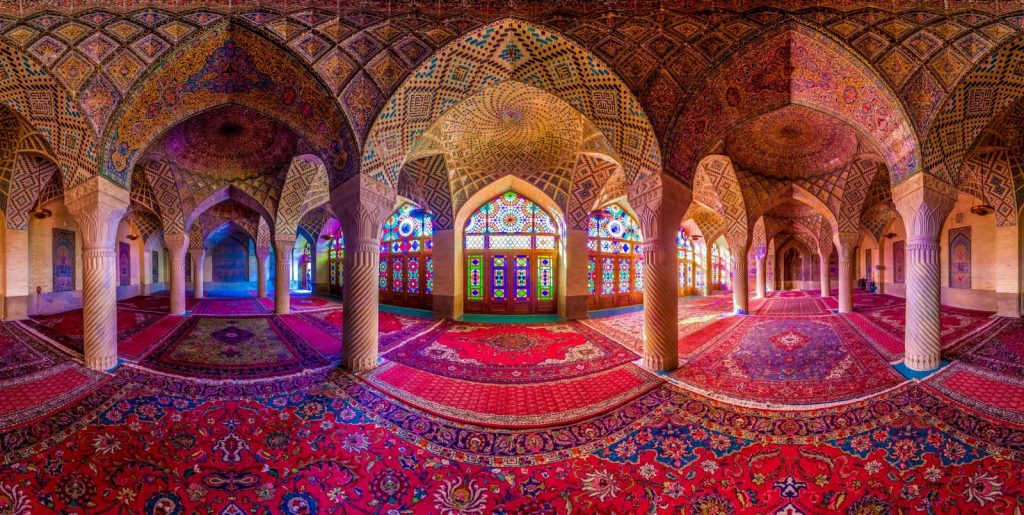
The Iranian carpet is one of the oldest handicrafts in the world, with a history dating back over two and a half millennia. The famous “Pazyryk Carpet,” discovered in the frozen tombs of Siberia, stands as a testament to the skill of Iranian weavers. During the Achaemenid era, carpets were not merely utility items but symbols of royal grandeur and majesty. In the Safavid period, royal workshops in cities like Tabriz, Isfahan, and Kashan produced masterfully designed carpets that are now preserved in major museums worldwide. This rich history has transformed the Iranian carpet into a symbol of national identity and art.
An art product called a carpet
The carpet trade held a special place in ancient Iran. Trade routes like the Silk Road carried Iranian carpets to markets in Central Asia, the Caucasus, Anatolia, and the Mediterranean. Due to their durability, beauty, and natural colours, carpets were not only valuable in economic exchanges but also served as diplomatic gifts exchanged between kings. In essence, from its very beginnings, the Iranian carpet was considered both an artistic masterpiece and an economic asset, which helped it secure a special place in the minds of people worldwide.
In the carpet weaving world, there are many technical terms, each shaping a part of this art’s identity. The “knot,” known in two types—Turkish (symmetrical) and Persian (asymmetrical)—is the foundation of the weave. “Rajshomar” (knot count) indicates the density of knots per seven centimeters, with a higher number signifying higher quality. The “warp” or “chelleh” forms the carpet’s foundation, while the “weft” connects the warps. The “khameh” is the pile or wool/silk thread that plays a central role in its beauty. “Naghsheh” (design) includes patterns like ‘Lachak-o-Toranj,’ ‘Shah Abbasi,’ and ‘Afshan.’ ‘Shirazeh’ (selvedge), ‘gilim–baf’ (flat weave), ‘ahar-o-pardakht’ (finishing and shearing), ‘rofu’ (repair), and ‘khab-e-porz’ (pile nap, pile direction) are other common terms. In nomadic regions, types like Gabbeh, Qashqai, Afshar, and Baloch are also recognised as distinct varieties.

Types of Persian carpets
Iranian carpets encompass a wide spectrum of types, including Qali (large rug), Qalicheh (small rug), Gabbeh, and Kilim (flat-woven rug). Their remarkable variety largely stems from geographical origin, with each region contributing to its own distinctive designs and techniques.
Iran is home to a rich variety of carpet-making traditions. The northwestern cities of Tabriz and Heris are famous for their intricate and finely woven carpets. In contrast, the carpets of Bijar and Senneh in Kurdistan and Kermanshah are so dense and rigid they are known as “Iron Carpets.” While Hamedan produces simple, rustic rugs, central Iranian cities like Kashan, Na’in, and Isfahan are celebrated for their masterful and silky designs. Finally, Qom is especially known for its valuable silk carpets. In the south and southwest, Qashqai, Bakhtiari, and other nomadic rugs reflect the cultural heritage of the tribes. Kerman has long been a distinguished center for fine-knotted carpets, whereas in the east, Mashhad and Turkmen Sahra are praised for their distinctive weaving styles. This diversity illustrates how every region of Iran enriches the heritage of Persian carpets with its own unique artistry and tradition.
Iranian carpet exports
The value of Iranian carpet exports has fluctuated significantly in recent years. In 2021, the export value was about $64 million. This figure dropped to approximately $50.7 million in 2022 and then slightly increased to about $53.5 million in 2023. However, based on initial estimates, exports fell to about $41.7 million in 2024. This decline stemmed from diminished demand in certain markets, the impact of sanctions, and intensified competition from other producing countries. Nevertheless, the Iranian carpet still holds a special place in the global market, and efforts are underway to implement digital marketing and diversify target markets.
The destination countries for Iranian carpet exports have also changed over the past three years. Germany remains one of the largest buyers of Iranian carpets. Collectors in France and Italy, along with Japan and Switzerland, are among the regular customers. Alongside these countries, the UAE and China have taken a significant share as important regional markets. Countries like Qatar, Iraq, Turkey, and Russia have also served as complementary destinations. In recent years, the decline in the U.S. share due to trade restrictions (sanctions) has been evident. Despite the challenges, Iranian carpets continue to reach more than sixty countries across the globe. The geographical diversity of these markets highlights the continued export potential of this unique art-industry.